
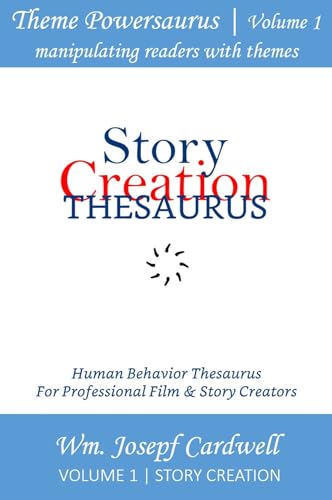
Story Creation Thesaurus: manipulating readers with themes (Theme Powersaurus)
Product Description
Story Creation Thesaurus: manipulating readers with themes (Theme Powersaurus)
What do these IDEAS have in common?
1 | Alliance | Desire | Power
2 | Anger | Bigotry | Cruelty
3 | Faith | Wealth | Love
All are Themes. Yet, not all Themes are created equal. Line one contains Neutral themes. Line two contains Negative themes. Line three contains Positive themes.
So what is a Theme? A theme is any IDEA that impacts a literary Character in three dimensions. These dimensions are called impact surfaces.
1st dimension | Personal Impact
2nd dimension | Relational Impact
3rd dimension | Social Impact
Every day as we move through life, we interact on these three levels.
PERSONAL IMPACT
We look at ourselves in the mirror, we chat silently in our head. This is personal impact. We do not interact with self, we interact with hatred or love of self. Authors call this internal dialog.
RELATIONAL IMPACT
As soon as we meet another person (an Impact Character) whether that person is our sibling, our roommate, our spouse or our kids; we interact on a relational level. Huge emotional interactions here.
SOCIAL IMPACT
And finally, when we head out to the day, to the beach, to shop, to work, to dance, we interact and impact with society. This is the third dimension. Only IDEAS impact people on all three levels! Personal, Relational, Social. This is why a THEME must be an Idea rather than a Person, Place or a Thing.
THERE IS A BONUS!
Any idea that impacts personal emotions, relationships and society impacts everyone, including readers and movie watchers. That’s how you manipulate your readers. You use themes the audience intuitively understands, whether they are conscious of them or not. That’s why themes are so powerful. They are subtle manipulators of audience expectations through their emotional reasoning.
This work provides 150 THEMES divided into usable categories including Negative, Neutral and Positive themes. So no need to go searching for them. Just know this – themes are a writer’s best weapon. And by the time you finish this book, you will not only have a solid understanding of themes, you will have a storytelling strategy to guide your through the process of creating a well-told story from beginning to end.
As far as I know, this is the only work that will allow you to answer this fundamental question:
Do I have all the components I need to tell my story?
Welcome to whole new world of writing based on themes.
Technical Specifications
You might also like

Emotion Thesaurus: manipulating readers with emotions (Theme Powersaurus Book 3)

Character Reactions from Head to Toe (Indie Author Resources Book 1)
The Emotion Thesaurus: A Writer's Guide to Character Expression (Second Edition)

How to Write a Dynamite Scene Using the Snowflake Method (Advanced Fiction Writing Book 2)

The Emotional Wound Thesaurus: A Writer's Guide to Psychological Trauma
The Craft of Scene Writing: Beat by Beat to a Better Script

Secrets Of Description & Voice (Screenwriting Blue Books Book 9)

The Urban Setting Thesaurus: A Writer's Guide to City Spaces