
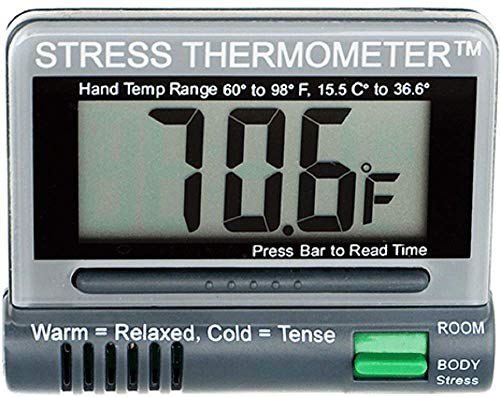
Digital Stress Thermometer

Product Description
Digital Stress Thermometer
- Great for learning hand warming relaxation techniques
- See your stress response; train yourself to relax
- Measure relaxation effectiveness with quantitative data
- Cold hands are tense, warm hands are relaxed
- Clock and room temperature feature
The Stress Thermometer lets you see changes in your hand temperature, which is a reflection of your blood flow and a measure of your stress response. When you're stressed, tiny blood vessels under your skin constrict, and the flow of blood is redirected to your major muscles and internal organs. This is why your hands feel cold when you are under stress. The blood has been rushed away from your fingers, to the more vital parts of your body because of the fight-or-flight response. Hand temperatures can range greatly, from a low of 60° to as high as 99° F. When you're stressed, 5° changes can take place in seconds. The basic rule for interpreting your temperature change is simple, "Cold hands are tense, warm hands are relaxed." Your temperature is connected to your stress level. When you are tense, the blood circulation in your hands and feet is reduced. This reduced circulation causes a drop in temperature. Relaxing increases your peripheral blood circulation, warming your hands and feet. With simple stress reduction exercises, you can increase your blood flow, raising your temperature. The Stress Thermometer lets you gauge your baseline temperature and stress level, and see moment-to-moment skin temperature changes as they relate to your stress level. Breathing from your lower diaphragm and not your upper lungs, inhale fully through your nose. Hold your breath for a moment, and exhale slowly through your mouth. Repeat, aiming for 6-12 breaths per minute. Watch your temperature increase as you relax. Measures temperature 58°-150°F (≈14°-65°C). Reads in increments of 0.1°. Updates temperature display every 2 seconds. Switch between Fahrenheit and Celsius. 3/4" high LCD display
Technical Specifications
You might also like

Biodots Package with different counts (100)

GSR Galvanic Skin Responses biofeedback Unit

The Clinical Handbook of Biofeedback: A Step-by-Step Guide for Training and Practice with Mindfulness

Biodot Instruction Card--Biodot not included

Biofeedback and Mindfulness in Everyday Life: Practical Solutions for Improving Your Health and Performance

Mindfield eSense Skin Response (black) - GSR sensor for iPhone & Android

D.O. Weaver NuPrep Skin Prep Gel, 4oz Tube, 3/pk by D.O. Weaver

A Consumer'S Guide to Understanding Qeeg Brain Mapping and Neurofeedback Training

Polyvagal Flip Chart: Understanding the Science of Safety (Norton Series on Interpersonal Neurobiology)

Stress Squares - 1 Sheet Stress Squares, 972 per Sheet