
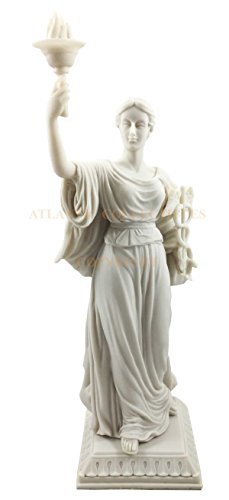

Ebros Greek Roman Goddess of Health And Medicine Hygiea Statue In Classical White Resin Finish Hygeia Figurine Daughter Of Asclepius Epione For Physicians Doctors And Health Care Proffesionals
This Beautiful Goddess Hygeia sculpture is made of high quality polyresin. It is meticulously hand painted and polished. Color tone may vary from pictures.
This Beautiful Goddess Hygea sculpture is 12" tall, 4" wide and 3.5" deep approximately.
In Greek and Roman mythology, Hygieia, was a daughter of the god of medicine, Asclepius. She was the goddess/personification of health.
This is an Ebros Gift exclusive collection.
In Greek and Roman mythology, Hygieia (also Hygiea or Hygeia, Greek Ὑγιεία or Ὑγεία, Latin Hygēa or Hygīa), was a daughter of the god of medicine, Asclepius. She was the goddess/personification of health (Greek: ὑγίεια - hugieia[1]), cleanliness and sanitation. She was the daughter of Asclepius and Epione. Hygieia and her five sisters each performed a facet of Apollo's art: Hygieia ("Hygiene" the goddess/personification of health, cleanliness, and sanitation), Panacea (the goddess of Universal remedy), Iaso (the goddess of recuperation from illness), Aceso (the goddess of the healing process), and Aglæa/Ægle (the goddess of beauty, splendor, glory, magnificence, and adornment). Hygieia also played an important part in her father's cult. While her father was more directly associated with healing, she was associated with the prevention of sickness and the continuation of good health. Her name is the source of the word "hygiene". She was imported by the Romans as the Goddess Valetudo, the goddess of personal health, but in time she started to be increasingly identified with the ancient Italian goddess of social welfare, Salus.