
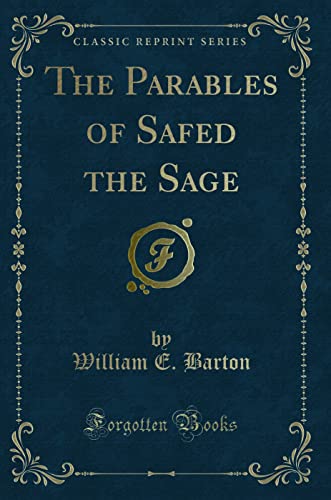
The Parables of Safed the Sage (Classic Reprint)
Product Description
The Parables of Safed the Sage (Classic Reprint)
Excerpt from The Parables of Safed the Sage
All true teaching is by parables. The relativity of knowledge compels us to learn, if we learn at all, by comparison and contrast. We have no words for things of the intellect and soul that are not first words of physical things or states. Hence we must always be taught what the kingdom of heaven is like unto.
The brief chapters which make up this book have appeared in successive issues of The Advance during recent months. They are a literary recreation, and something more; for they have a serious purpose. They were begun with little thought that they would be continued more than a few weeks, but as readers of The Advance appeared to like them, and other papers copied them, they have continued to appear. The first one was written while the writer, accompanied by his wife, was making a tour of the Mississippi River in the spring of 1915. The manner in which the mate of the boat addressed the colored deckhands afforded some food for thought. The parable does not reproduce the mate's language precisely, but the meaning and intent are preserved.
The successive parables of the Hollyhocks have met with more of apparent favor than any of the others, and many inquiries have been made whether the experience out of which they grew was real or imaginary. It was a real experience, and occurred essentially as described.
About the Publisher
Forgotten Books publishes hundreds of thousands of rare and classic books. Find more at www.forgottenbooks.com
This book is a reproduction of an important historical work. Forgotten Books uses state-of-the-art technology to digitally reconstruct the work, preserving the original format whilst repairing imperfections present in the aged copy. In rare cases, an imperfection in the original, such as a blemish or missing page, may be replicated in our edition. We do, however, repair the vast majority of imperfections successfully; any imperfections that remain are intentionally left to preserve the state of such historical works.


